
Computer-aided design of lacunar fractal polygons
Published in Computer Aided Geometric Design, 2026
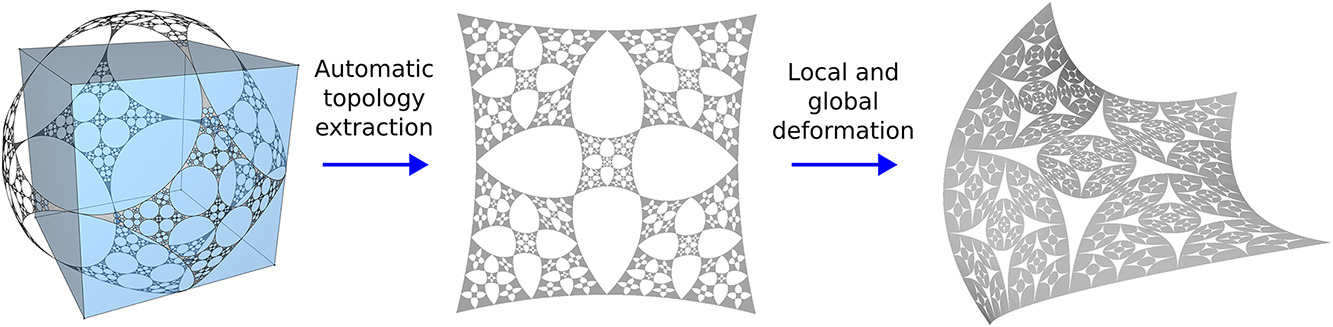
Abstract: Imagining and designing complicated topologies, such as multi-scale lacunar objects, is challenging. Generally, designers generate these structures from ad hoc algorithms with limited options for parametrization. Some models, like Boundary Controlled Iterated Function Systems (BC-IFS), provide a complete formalism for describing and controlling both their topology and geometry. However, encoding the topology involves abstract knowledge and can be tedious to do manually. On the other hand, polyhedral crystallographic circle packings provide a complete construction of fractal shapes arising from polyhedra. The geometry of such packing relies on circles, but the simple input polyhedron entirely determines their topology. This article shows how the BC-IFS model can encode the topology of fractals obtained from polyhedral crystallographic circle packings. Our method automatically deduces the topological BC-IFS constraints directly from the polyhedron’s structure. As a result, polyhedra serve as an intuitive topological editor for creating multi-scale lacunar polygons. Finally, BC-IFS allows the end-user to modulate the global aspect using control points and refine local details with subdivision points.
Recommended citation: Boris Bordeaux, Christian Gentil, Iván Rasskin, Lionel Garnier, "Computer-aided design of lacunar fractal polygons." Computer Aided Geometric Design, 2026